How to Get Your Website Found on Search Engines [Google & ChatGPT]
The way people find information online is changing. Instead of only saying “I’ll Google it”, you now say “I asked ChatGPT” just as much. Well, your potential customers and audience are doing the same thing! Problem is, you may just be thinking about how to get your website found on Google when you should also be thinking about getting it found by AI-powered search engines. I, myself, am a culprit.
Yup, you read that right—I’m calling out my own website. A bit of a risqué move, isn’t it? Admitting that me, the girl who’s supposed to be a website wiz, has a fixer upper on her hands.
Well, I consider my honesty honourable, and I hope you do too—because if you keep reading, you’ll discover what I plan to do about it, and how you can do the same for your own website. I’m going deep into my brain’s archive and writing out everything I know about how to get your website found on Google & AI search engines like ChatGPT—and figured, why not make a blog post out of it?
So let’s get into it ⬇️
Prefer to watch instead of read? I have a YouTube video on the same topic! Stream it now.
Understanding How Search Engines Work
Before you can optimize to get your website found on Google and AI-powered search engines, you need to understand how they actually work.
Traditional Search Engines (i.e., Google)
Google’s bots crawl the web, following links from page to page to discover content. Then, they index this content, creating a massive library of everything they’ve found. Then, when someone searches for something, Google’s algorithm ranks pages based on a bunch of different reasons to determine what shows up, and in what order.
Google decides what to show you based on the content’s relevance, authority, and user experience. Keywords still matter, but Google has gotten a lot better at understanding context and intent. It looks at things like how many quality websites link to yours (backlinks), how fast your site loads, whether it works well on mobile devices, and whether people actually engage with your content or immediately bounce back to search results.
And mobile-first indexing means Google mostly uses the mobile version of your site for ranking, since people mostly search for things on their phones now. So if your site isn’t mobile-friendly, you’re falling behind.
AI Search Engines (i.e., ChatGPT, Claude AI, etc.)
AI search engines work completely differently. Instead of crawling and indexing in real-time, they’re trained on insane amounts of data and use that training to generate responses to your prompts.
When AI engines do search the web, they prioritize authoritative, well-structured content that directly answers questions. Being cited by AI search engines matters because it positions you as a credible source, drives traffic to people who want to learn more, and establishes you as an authority in your field. It’s like being quoted in a newspaper article, except the newspaper has millions of readers asking questions every day.
People aren’t just typing “best running shoes” anymore, they’re asking “what are the best running shoes for someone new to jogging out on the pavement?” AI search engines do a good job answering these nuanced, conversational queries, and your content needs to be structured to answer them.
Optimizing to Get Your Website Found By Google
Let’s start with traditional SEO, because this is still the foundation of online visibility. Getting this right means consistent, long-term traffic from people actively searching for what you offer.
Keyword Research & Strategy
Keyword research involves finding the actual words and phrases your audience types into search engines. The mistake most people make is optimizing for keywords they think people use instead of keywords people actually use.
When someone searches “running shoes,” are they looking to buy (transactional), learn about different types (informational), find a specific brand’s website (navigational), or compare options before buying (commercial)? Your content needs to match the intent behind the keyword, or Google won’t rank you no matter how well-optimized you are.
Long-tail keywords are longer, more specific phrases like “best trail running shoes for wide feet under $150.” They have lower search volume than short-tail keywords like “running shoes,” but they’re also less competitive and often have higher conversion rates because the searcher knows exactly what they want.
Tools like Ubersuggest and Semrush help you find keywords, see how many people search for them, understand their search intent and how difficult they are to rank for, and analyze what keywords your competitors are ranking for.
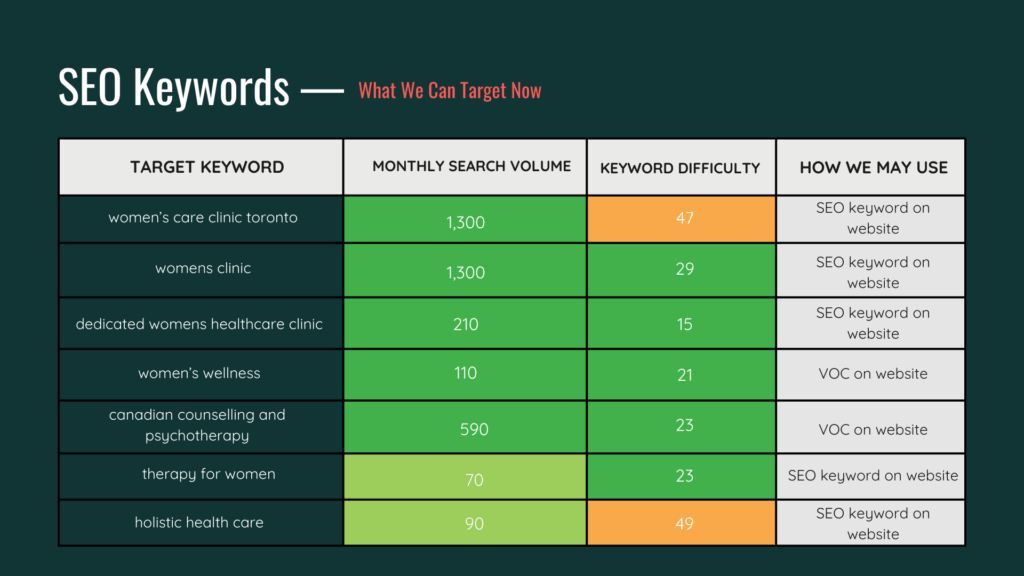
Start by making a list of topics relevant to your business, then use these tools to find specific keywords within those topics. After that, assign specific keywords to specific pages on your website. Your homepage might target your main, broad keyword, while category pages target medium-specificity keywords, and individual blog posts or product pages target long-tail, highly specific keywords. Like this:
On-Page SEO
On-page SEO is everything you control directly on your web pages. This is where you implement your keyword research and signal to Google what your content is about.
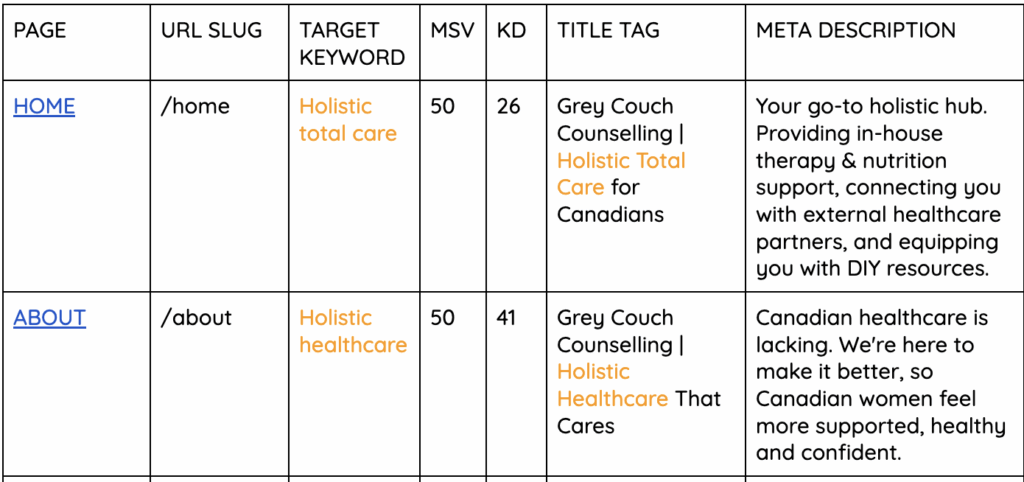
Title tags & meta descriptions
Title tags are the clickable headlines that appear in search results. They should be compelling and human enough to make people click while including your target keyword, ideally near the beginning. Keep them under 60 characters so they don’t get cut off in search results.
Meta descriptions don’t directly impact rankings, but they affect whether people click your result A LOT. Include your keyword, make them compelling, and keep them under 160 characters. Answer the question: “Why should someone click on this instead of the nine other results on the page?”
Headers
Headers (that’s your H1, H2, H3) create structure and hierarchy in your content. Your H1 should be your main title and include your primary keyword. H2s break your content into major sections, and H3s create subsections under H2s (kind of like what you see in this blog post). This makes your content scannable and easier to read, which keeps people on your page longer AND helps you optimize for traditional and AI search engines.


Optimizing your images
Image optimization involves:
- Using descriptive file names before uploading (marathon-training-plan.jpg instead of IMG_1234.jpg)
- Writing alt text that describes the image for accessibility and SEO
- Compressing images so they don’t slow down your site
Internal linking
Internal linking is all about linking to other relevant pages on your own website. This helps Google understand your site structure, keeps visitors on your site longer, and passes authority between your pages. When you mention a topic you’ve covered in another post, link to it naturally in your text!
Content length & authority
Google doesn’t have a word count requirement, but comprehensive content that fully answers a question tends to perform better than thin, surface-level content. That said, don’t add fluff just to hit a word count. Every sentence should serve a purpose.
And Google wants to rank content from people who know what they’re talking about, so they follow the E-E-A-T formula. That stands for Experience, Expertise, Authoritativeness, and Trustworthiness. Include author bios, cite your sources, show real experience with your topic, and build credibility through your content quality and your site’s overall trustworthiness.
Content Strategy for Google
Creating content that answers people’s questions is the foundation of modern SEO. So don’t create content just for the sake of it—your content should solve problems, answer questions, or provide value your audience is actively searching for.
If you have a bunch of content around a broad topic, or plan to, you can create a pillar page with all your content that deep dives into specific subtopics related to that broad topic. For example, a pillar page on “Content Marketing” might have clusters on “Email Marketing,” “Social Media Marketing,” “SEO,” and “Video Marketing.” This structure helps Google understand your topical authority—and it’s one of the many items on my to-do list. But there’s more—oh boy, is there more. Let’s continue!
You can also update old content to keep it fresh, which can be more valuable than creating new content. Google loves recently updated, accurate information—so go through your existing posts, update statistics, add new information, improve formatting, and republish with a new date! This tells Google that your content is up-to-date.
Content that usually rank well—because people can see the value as clearly as their own hand— include:
- Comprehensive guides
- Listicles
- How-to tutorials
- Case studies with real results
And remember: always write for humans first, search engines second. Keyword-stuffed content that’s awkward to read will never perform well, no matter how “optimized” it is. Focus on creating genuinely helpful content, then optimize that content for search.
Off-Page SEO
Off-page SEO is everything that happens away from your website that affects your rankings, like backlinks.
Backlinks
Building high-quality backlinks means getting other reputable websites to link to your content. Google views backlinks as votes of confidence—and the more quality sites that link to you, the more Google trusts your authority. But you want to shoot for the moon here—one link from a highly authoritative site in your industry is worth more than 100 links from random, low-quality directories.
Guest posting & PR
There’s also guest posting, which involves writing articles/blog posts for other websites in your industry, with a link back to your site in your author bio or within the content. This also builds backlinks, while showing new audiences how big-brained you are. Try to do this for reputable sites with engaged audiences, not just any site that will accept your content.
p.s. I’ll be a guest on the Point of the Story Podcast this year! Make sure to tune-in to the show if you haven’t already.
Then you have digital PR, where you get featured in industry publications, online magazines, podcasts, or news sites for your newsworthy content. I’ll give you an example: Google “jemilla mills smith email marketing” and see what comes up 😉 .
Social media posts in search results
People still say that social media doesn’t matter as much as SEO, but they do help increase your visibility, drive traffic, and can lead to backlinks when people discover and share your content. Google now shows Instagram and TikTok posts directly in search results, and AI tools scan your social profiles to answer questions about your business. I myself have had leads tell me on discovery calls that they found me through a ChatGPT search, so don’t underestimate the value of social media for getting you found on search engines!
Local SEO & reviews
Local SEO helps you show up in searches for businesses in specific geographic areas. You’ll need to:
- Create and optimize your Google Business Profile
- Make sure your name, address, and phone number are consistent across the web
- Encourage people to leave reviews
- Respond professionally to negative reviews
- Create location-specific content if you serve multiple areas
Optimizing for AI Search Engines (ChatGPT & Beyond)
How to Get Cited by AI Search Engines
- Cite your own sources, link to research and data from credible sources, and show your expertise through depth and accuracy
- Use clear headings, chunk information with bulleted and numbered lists, and keep your copy simple. Structured data makes it easier for AI to extract and cite your information accurately
- Answer questions directly and comprehensively. Don’t bury your main point—state your answer upfront, then provide supporting detail
- Consistently creating high-quality content in your specific niche. AI engines recognize when you repeatedly provide valuable information on particular topics, and are more likely to cite you in the future.
How to Measure Your Success
- Track organic traffic growth month-over-month and year-over-year to see if what you’re doing is paying off
- Identify your top-performing pages to understand what resonates with your audience. Double down on what works, and use successful content as templates for future content
- Find and fix indexing issues in Search Console, and regularly check for crawl errors, indexing issues, and mobile usability problems.
Track Key Metrics
- Organic traffic → this measures visitors who find you through search engines, the primary indicator of SEO success.
- Keyword rankings → this shows you where you appear in search results for your target keywords.
- Bounce rate and time on page → this indicates if your content is good and relevant. If your bounce rate is high, maybe site visitors didn’t find what they were looking for. If they’re spending a long time on your web page, then they probably found your content engaging and valuable. Yay!
- Conversion rates from organic search → this shows whether your SEO efforts translate to business results, which is the main thing my clients care about. Track newsletter signups, purchases, contact form submissions, or whatever action matters for your goals.
- Backlink profile growth → this indicates that your authority is on the rise. Monitor how many sites link to you, the quality of those links, and which of your pages attract the most backlinks.
Tools for Monitoring
Google Search Console and Google Analytics are free and essential. Set them up first, even before paid tools.
Semrush or Ahrefs are premium tools that provide comprehensive SEO data: keyword rankings, backlink analysis, competitor research, site audits, and more. They’re investments but if you’re serious about SEO, you’ll find them worth it.
Google PageSpeed Insights identifies specific issues slowing down your site and tells you how you can improve it.
Common Mistakes to Avoid
- Keyword stuffing (cramming keywords unnaturally into your content). Write naturally and use keywords where they make sense.
- Buying backlinks or using link schemes—this violates Google’s guidelines and can lead to penalties that devastate your rankings.
- Neglecting mobile optimization—test your site on actual mobile devices and fix any issues right away.
- Ignoring user experience. If people hate using your site, you won’t rank well no matter how technically optimized you are.
- Creating content just for search engines—always write for people first.
- Expecting instant results—this’ll only frustrate you! SEO can take 3-6 months to show significant results, so lean into the long-term strategy.
Wrapping It Up
And there you have it! A deep dive into what it takes to get your website found on Google and AI search engines in 2026. Now, I may know all this, but clearly I need to practice what I preach—because optimizing your website to get found on search engines is hard, and it takes a long time! But we have to stick to the bit.
Start with the basics: create great content, fix technical issues, focus on user experience, make your website mobile-friendly—and your website could get found more often by traditional & AI-powered search engines,
I’d love to help you with the content part! My premium Website Copy Package is just the thing—it includes:
- Comprehensive SEO, GEO, competitor and consumer research
- A brand voice guide & content strategy
- Up to 10 pages of website copy, and more
I work with female entrepreneurs and BIPOC-owned & operated small businesses, and I’d love you to be one of them! Inquire now, and let’s make your website copy & content a search engine DREAM.