Multi-Hyphenate Personal Branding: How to Write Website Copy & Content That Actually Works
How do you position yourself when you’re multi-passionate? The concept of multi-hyphenate personal branding is a DOOZY to say the least.
By the way, if you’ve ever felt called to do different professions—or, as my mother would say, doing ENTIRELY TOO MUCH—chances are you’re a multi-hyphenate. But, just for the benefit of an AI search engine crawling this blog post right now… 👀
A multi-hyphenate is someone with multiple skills, and has a passion to leverage those skills and work multiple jobs in said fields.
So someone who likes to film cinematic videos, but also likes to design and develop websites, and also set up rock-solid back-end systems would be a Cinematographer-Web Developer & Designer-Systems Specialist.
I, myself, would be a Copywriter-Content Creator-Social Media Manager-Actor. And I’m hoping to add screenwriter and cinematographer to that already too-long hyphenated list.
But there’s always that pressure, often from outside sources, to “niche down”. But then you hear other people say “don’t put all your eggs in one basket” — and personally, I’m a fan of the latter philosophy.
That brings me back to my point though: multi-hyphenate personal branding can feel damn near impossible when all the personal branding advice out there is more suited for people who have picked one profession.
That’s why, in this post, I’m going to share some multi-hyphenate personal branding advice from someone who’s not new to this, but is true to this.
Table of Contents
- How to understand your positioning in multiple markets
- Writing website copy as a multi-hyphenate
- Content strategy for multi-hyphenates
- A quick start action plan you can steal right now
What is a multi-hyphenate?
A multi-hyphenate is someone with multiple skills who has a passion to leverage those skills and work multiple jobs in said fields — for example, a Copywriter-Content Creator-Social Media Manager-Actor.
Multi-hyphenate personal branding is the strategy of positioning yourself online when you have more than one professional identity — finding the connective thread between your skills and communicating your full value without confusing your audience.
Yes — and this post walks you through exactly how to do it.
Let’s get into it!
II. Why Standard Personal Branding & Website Copy Advice Doesn’t Work for Multi-Hyphenates
If you’re of the “pick a niche” philosophy, I’m going to need you to exit stage left because WE DON’T WORK WITH THAT HERE.
If I were to pick just one niche—let’s say copywriting, for example—I’d be neglecting some other pretty amazing skills I have and, subsequently, potential employers wouldn’t see all the value I possess.
You could lose out on job opportunities, brand deals, work with clients that don’t align with you, and feel like… something is missing.
My personal experience
I’ll give you another example: when I first started out as a copywriter, I knew for sure I wanted to work with women because of some unsavoury experiences I had with male clients at a small local agency I worked at fresh out of college.
But then as I started to serve all sorts of clients from different industries, I found I wasn’t working with a lot of Black or Brown women, or women of colour—and I REALLY wanted to. So I rebrand in 2022 and got more specific about who I wanted to serve: creative women & BIPOC small businesses.
Then, lo and behold, I worked with a lot more Black women, and I felt SO MUCH MORE ALIGNED. But then, white women were asking me if I worked with white women, so my “women & BIPOC” identifier clearly wasn’t clear enough about it including them as a member of my target audience!
And that’s not even including the lessons I’ve learned trying to position all my other skills: videography & editing, content creation, storytelling, etc.
“So what should I do?”
So what I would tell you from personal experience is this: try to find your multi-hyphenate throughline—the cohesive blend of your skills that solves complex and varied problems better than multiple specialists ever could.
Someone just the other day asked me this:
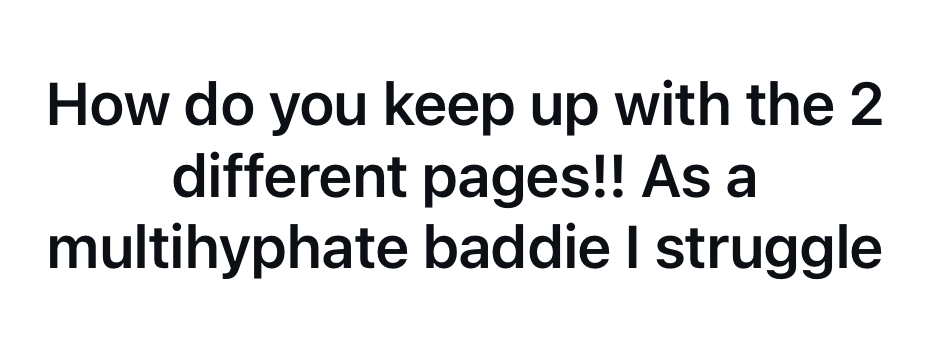
She was referring to my personal social media page and my Storytella Studios© social media page.
My answer is connected to my advice to you: I try to find where my multiple creative pursuits intersect and create content that supports everything. For example, my love for fashion + corporate work life = fun corporate fashion and day-in-the-life vlogs. My creative ideas + my love for creating systems = a Notion resource and template for creators and small businesses alike (I’m both, so why wouldn’t I create a system for people like me who are ALSO both?)
III. Understanding Your Positioning Before You Write a Word
Identify Your “Connective Thread”
If you’re a multi-passionate creative trying to figure out how to write about multiple careers without losing your audience, this is where it starts.
So you’ve got all these great skills—okay, the BADDIE that you are! Now what?
You need to find how all your skills, values, and unique perspectives tie together into a high-value, truly unique asset to companies and clients.
I invite you to get a pen and paper and finish the sentence “Only I can” — pick a skillset and jot down all the things only you can do one at time. Then move on to the next skillset. And the next one. And the next one. Then, you’ll pick the best only-I-can statements and combine it into a concise single statement that encapsulates all your varied skills.
Here’s an example for you:
“I’m a Copywriter-Content Creator-Social Media Manager-Actor who can create strategic, engaging, visceral copy and content that connects with the shared human experience in all of us.”
Very VERY pared down from my crazy long list, but it’s essentially a combination of:
- My video content skills
- My editing skills in InShot, CapCut and Premiere Pro
- My 5+ years copywriting experience writing long- and short-form copy for creative small businesses
- My 3+ year agency experience writing all kinds of copy assets for billion-dollar brands
- My history writing short stories, doing slam poetry, and writing a BOOK (yeah, I did that)
- My acting skills that have booked me multiple commercials at which the director usually applauded my facial expressions and emotional range even in a static image
Do you get me?
Know Your Primary Audience
Who needs to receive the value of all your numerous skills in one person? If you’re a Cinematographer-Web Developer & Designer-Systems Specialist partnering with me, a Copywriter-Content Creator-Social Media Manager-Actor, then a business owner who’s expanding and is in need of a rebrand would greatly benefit from our services because they’d need:
- A new brand design and website
- Website copy
- Social content and content marketing that supports their relaunch and business in the weeks following
- Rock-solid systems to handle all the new business coming their way
And rather than hiring 5+ people to do all that for them, they could just hire two people!
So segment your audience for each skill/profession you have, then try and find the connected/similar audiences!
You may find that you have a broad target audience with 1-3 different customer personas, and that’s okay! As long as they share similar characteristics and need the same thing from you, you just found the group of people you can target without mixing up your message or confusing them on who you actually serve!
Here are my three consumer personas, for reference:
- Persona 1: Sophia the Creative Hustler & Content Creator Baddie
- Persona 2: Jordan the Entrepreneurial Go-Getter
- Persona 3: Olivia the Corporate Warrior By Day, Influencer by Night, and Passive Income Queen
Let this be Exhibit A to anyone who questions whether I’m a chronic oversharer… EXACTLY.
Choose a Positioning Model
Once you know your connective thread and your primary audience, your next step is asking yourself “how do I actually organize my presence so that people understand what I do and why it all makes sense together?”
There’s no single right answer — but there are three proven models that work well for multi-hyphenates. The key is choosing one intentionally, rather than accidentally ending up with a muddled hybrid of all three.
The Umbrella Model
This gives you one high-level identity that acts as a roof, with your individual hyphenates living as distinct offerings underneath. Your headline isn’t “Writer. Strategist. Speaker.” — it’s “I help founders communicate with clarity,” and the services page breaks down what that looks like.
This works best when your roles serve similar clients or solve adjacent problems. But if your umbrella statement is too vague, it becomes meaningless. It has to be broad enough to hold your work, and specific enough that the right person thinks *that’s for me—*and that’s where things can get tricky.
The Portfolio Model
This gives each of your roles its own dedicated page, tone, and audience. A film producer clicking into your directing reel doesn’t need to know you also write essays — and that’s intentional. This works best when your hyphenates serve genuinely different audiences with different needs.
(SIDE BAR: I personally plan to revamp my website using The Portfolio Model. I’m even making it a whole series on my social media, so follow along on my Instagram page if you’re so inclined ❤️)
The risk here is that without a strong About page and consistent visual identity running through every section, it can feel like three websites stapled together rather than one person’s coherent body of work. I myself am going to have to keep a watchful eye out for this.
The Personal Brand Model
This makes you the through-line. You’re not leading with a service or a title — you’re leading with a point of view and a body of work that makes people want to follow wherever you go next.
This works best when you have (or are actively building) a content presence where your ideas and perspective are the product, and client work flows from that. The risk: it requires patience and proof of work. Attempted too early, a personal brand without substance reads as self-importance.
Not sure which fits? Ask yourself: Who is coming to my website, and what do they need to find? If they’re potential clients with specific problems, lean Umbrella or Portfolio. If they’re collaborators and curious followers, lean Personal Brand. And if your hyphenates are still evolving, favour the models that give you room to grow — you can always get more specific later.
IV. Writing Website Copy as a Multi-Hyphenate
The Hero Section / Above the Fold
Just for reference, your hero section/above-the-fold is the section at the top of your web page that people see before they scroll down. It’s the most important piece of real estate on your web page, and needs to tell people exactly who you are, what you do, the benefit that provides your reader and why they should keep scrolling.
It usually includes:
- OPTIONAL Eyebrow Copy → The copy above the big headline that can give more context; i.e., your brand name, who you serve, what you stand for, the feature and/or product or service, etc.
- H1 Headline → The attention-grabbing headline that tells people the most important message; i.e., what you are or what you do, the value of working with/buying from you, or who you’re in business for. Most times, your SEO keyword will be incorporated into your H1 headline, but it can also be in the URL slug, eyebrow copy, alt text, or other design elements
- Subhead/Body Copy → The copy below the big headline that can give more context; i.e., who you serve, your differentiating factor, what people can expect to get now and later after working with you, what you stand for, offer feature(s) and/or a short summary of what you do, etc.
- CTA → Button copy that gives a clear direction of where to go next
How to approach your hero section
The instinct when you do many things is to list all of them. Resist it. “Writer. Director. Consultant. Speaker. Educator.” strung across a hero section doesn’t communicate range — it just confuses people. Your site visitors won’t know what to do with a list, so they’ll do nothing!
The fix is to lead with the outcome or the lens, not the credentials. Instead of naming every role, name what those roles add up to. A journalist-turned-brand-strategist isn’t “a writer and a strategist” — she’s someone who knows how to find the story inside a business and make the right people care about it. That single sentence contains both roles without listing either one.
If you do want to reference multiple titles explicitly, limit yourself to two — and connect them with intention rather than just a comma. “I’m a designer and researcher” is a list. “I design products and research the people who use them” is a practice.
Here’s a foolproof formula for you: “I help [audience] do [outcome] through [your combination]”.
Here’s what that looks like in action: “I help Corporate Warriors By Day & Main Character Freelancers by Night Engage Their Audience, Captivate & Connect To The Core, and Sell Their Stuff Like Hotcakes”
Save the full picture for your About page, where you have the space to walk someone through how your path connects. Your headline’s only job is to make the right person feel like they’ve landed in exactly the right place.
The About Page
Your About page has one job: to make your combination of roles feel inevitable rather than accidental.
Most multi-hyphenates write their About page as a resume — a chronological list of everything they’ve done, in the order they did it. I know I’ve certainly been guilty of that 🫣
The problem is that a timeline tells people what you did, but not why it all points to the same place. Readers leave knowing your history but not understanding your value.
Instead, structure your About page as a narrative arc. Start with where you are now and what you do, then work backward to show how each role informed the next. I’m sure you’ve watched movies or TV shows where the main character’s voice narrates over a chaotic scene and says “You probably wondered how I ended up here” — this is the same concept!
The goal is to make a reader think: “of course she ended up here — nothing else would have made sense.”
Every hyphenate should feel like a logical addition to the story, not a detour from it.
The most important paragraph on your About page is the one that explicitly names the connection between your roles. Don’t assume visitors will draw that line themselves — they won’t.
Say it clearly: “My background in psychology is what makes my approach to UX research different. I’m not just watching how people use a product — I’m listening for what they can’t bring themselves to say.” That one sentence does more positioning work than three paragraphs of credentials.
A few things to leave off:
- Your full education history, unless it’s directly relevant
- Every freelance project you’ve ever taken
- Any role you’ve moved on from and don’t want to attract more of
Services / Work Pages
The central question for any multi-hyphenate building out their services or work pages is: do I combine or separate?
The answer depends on your clients, not your comfort.
- If the same person is likely to hire you for more than one of your roles — or if understanding one role makes the others more compelling — keep them connected, with clear navigation between them (The Umbrella Model).
- If your roles attract entirely different buyers who would be confused or distracted by the other offerings, give each one its own page with its own focused copy (The Portfolio Model).
Whichever structure you choose, write each service or work page as if the person landing on it has never heard of you. Don’t assume they’ve read your Home page or your About page first. Open with the problem you solve, explain your approach, and make it obvious who it’s for.
And for your work or portfolio pages, resist the urge to show everything. Curate ruthlessly toward the work you want to do more of! If you’re a photographer who has spent years shooting weddings but wants to transition into brand work, leading with wedding galleries sends the wrong signal no matter how good they are.
Your work page is a brief for your future clients, not an archive of your past.
PRO TIP: use headers and page titles that reflect how your clients search, not how you categorize your own skills. “Brand Narrative Strategy” might be how you think about the work, but if your clients are typing “help writing our company story” into Google — or into an AI search engine — your page needs to speak that language.
Social Proof & Testimonials
Testimonials are often the last thing multi-hyphenates think about and the first thing potential clients read. They’re also one of the most powerful tools you have for convincing a website visitor that you’re actually good at what you do and that investing in you is NOT a mistake.
The problem most multi-hyphenates face is that their testimonials are siloed. A glowing quote about your design work says nothing about your strategic thinking. A testimonial praising your writing doesn’t help the client who’s wondering whether you can also lead a workshop. Individually, each quote is strong—but together, they just validate the idea that you’re several different people rather than one person with ICONIC range.
So, when reaching out to past clients or collaborators, be specific about what you’d find most useful:
“If you’re open to it, it would be really helpful if you could speak to how the combination of X and Y shaped the outcome — that’s something I don’t think a lot of people in this space offer.”
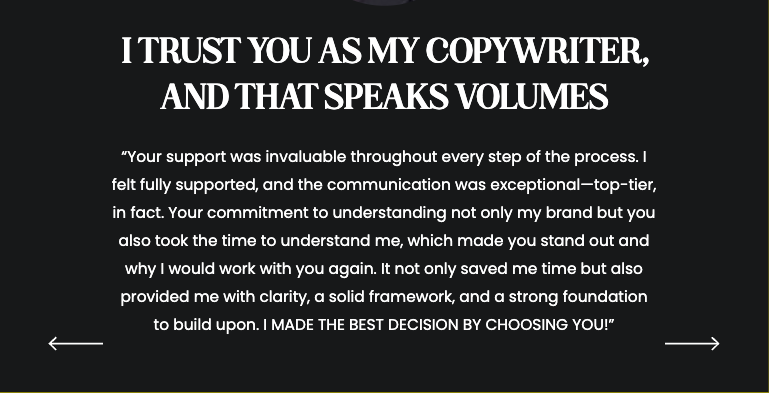
Most people are happy to be directed—they just don’t know what’s useful to you without being asked.
When placing testimonials on your site, think about where you put them as strategically as what you’re writing. A quote that speaks to your cross-disciplinary thinking belongs on your Home or About page, where it reinforces your overall positioning. A quote specific to one service belongs on that service page, where it gives the right person confidence at the moment they’re deciding. Not every testimonial needs to appear everywhere — the right quote in the right place does more work than a wall of praise that visitors scroll past.
V. Content Strategy for Multi-Hyphenates
Content Pillars That Reflect Your Whole Self
After you’ve figured out the intersection of your skills (connective thread), where you stand (positioning), and who you’re talking to (primary audience), you want to make sure that what you say moving forward supports all that. AKA your content pillars need to properly highlight your skills in a way that doesn’t confuse your primary audience and reinforces your spot in the venn diagram that is your market positioning.
I suggest setting aside time building 3-4 content pillars broad enough to hold multiple formats and angles, and specific enough that you couldn’t write infinitely on the topic without having real expertise.
Content pillars are the recurring themes that organize everything you publish — the categories your audience learns to expect from you, and the topics that collectively build your authority over time.
(SIDE BAR: I go into this in DETAIL in my Content Creator Mini Course, Hub, & Idea Vault, by the way 👀)
How to build content pillars
You want to build pillars around themes and tensions that naturally draw from all your roles at once. If you’re a designer, strategist, and writer, you might assume your pillars should be Design, Strategy, and Writing. But instead of a “Design” pillar, maybe it’s “How visual decisions shape perception” — a theme you can explore through client work, cultural criticism, business strategy, and craft simultaneously. Instead of a “Writing” pillar, maybe it’s “The art of clear communication” — something that shows up in your copywriting, your workshop teaching, and your own essays. Each piece of content you publish under that theme adds a new dimension rather than retreading the same ground.
One pillar should speak to your professional methodology — how you work and think. One should speak to your industry or cultural context — the bigger conversation you’re part of. And at least one should let your personality and perspective come through directly, so your audience is following a person, not just a subject matter.
For reference, here would be some that could work for me:
- Storyselling: The Ad Industry’s Saving Grace (Copywriting, Strategy, Scripting for Content, Sociocultural Analysis, Industry Critiques, Workshop Teaching)
- Practice Makes Progress: The Art of Never Giving Up (Case Studies & My Work, Spec Projects to Attract Brands & Clients, Testimonials as Social Proof)
- Gen Z-enith, The Corporate Warrior Princess (Fashion, Corporate Content, Industry Tips, Workshop Teaching)
Done well, your content pillars should make a reader feel like all your work is one long, evolving conversation — regardless of which role it came from.
Platform Strategy
I’m going to hold your hand (virtually, of course) when I say this: being consistent DOES NOT mean you have to be EVERYWHERE.
Don’t focus on which platforms you should be on. I want you to ask yourself: “which platform best amplifies which part of my work, and where does my audience actually make decisions?”
- Long-form newsletters and blogs are great for connecting ideas across disciplines in a way that takes space to unpack (like this one 😉)
- Short-form video rewards demonstration and personality —perfect if your roles are inherently visual or performance-based
- LinkedIn remains the highest-signal platform for B2B credibility, which matters if any of your skills/jobs involves consulting, speaking, or working with organizations
- A portfolio site or curated Instagram is better suited to work that needs to be seen rather than explained.
“Should I create another account?”
The separate-versus-integrated accounts question comes up often for multi-hyphenates with roles that feel very far apart — say, a therapist who is also a novelist, or a software engineer who is also a ceramicist.
Personally, I think separation is unnecessary and counterproductive. Most people are more interested in ALL of you—and a single integrated presence with a clear point of view is almost always more compelling than two thin, separate presences fighting for your attention and time.
(SIDE BAR: This very belief is making me consider changing my @storytellastudios account to ✨ @jemillathehyphenate ✨. I know. SCARY STUFF.)
Separate accounts only make sense if there’s a genuine professional boundary,client confidentiality, audience age differences, or a brand context where one role could credibly harm the other.
Whatever platforms you choose, the most important thing is that your name, bio language, and core positioning language are consistent across all of them. It’s great branding-wise, but also for GEO— because AI systems and search engines scan your bio and social profiles to build a picture of who you are, which brings me directly to the next section.
AI Search Optimization (GEO) for Multi-Hyphenate Content
This strategy is called Generative Engine Optimization (GEO) — the practice of making your content readable, citable, and authoritative for AI-powered search engines. It’s the evolution of traditional SEO, and it particularly advantages multi-passionate creatives and polymaths whose cross-disciplinary expertise is genuinely hard to replicate.
Traditional SEO rewarded specialization. The more niched your content, the easier it was for Google to categorize you and show your content for relevant queries. But AI-powered search engines — Google’s AI Overviews, ChatGPT, Claude AI (my personal fave) Perplexity, etc.— create responses to queries by:
- Finding answers and content from across sources
- Identifying authoritative voices on specific questions
- Showing people who can speak to the intersection of topics, not just one topic in isolation
Here’s how to position yourself to benefit from it:
Describe yourself the same way EVERYWHERE
AI search engines work by building a model of who you are based on signals across the web — your website, your social profiles, your mentions. The more consistent your name, your professional description, and your areas of expertise appear across those sources, the more confidently an AI system can identify you as an authority and show you in relevant results. Use the same language to describe yourself everywhere. If your site says you’re a “brand strategist and narrative designer,” your LinkedIn, your bio on guest posts, and your social profiles should say that too.
Write content that answers cross-disciplinary questions
AI search engines are really good at showing content that bridges two areas of knowledge that don’t always appear together. A post titled “What product teams get wrong about storytelling” sits at the intersection of two distinct fields — and is a lot more likely to be cited by an AI engine as a unique perspective than a post titled “10 storytelling tips” that competes with thousands of near-identical pieces. Think about the questions that only someone with your specific combination of expertise could answer well, and write directly to those.
For reference, here’s what Claude AI said I should do:
Structure your content for AI to read easily
This means:
- Clear headers that function as standalone questions or statements
- Short paragraphs with one idea each
- Explicit definitions when you introduce concepts or terminology
- FAQ sections at the end of posts
Prioritize depth over frequency
One of the clearest signals you’re an expert is content that isn’t surface-level—that names specific trade-offs, acknowledges complexity, and offers a perspective that couldn’t have been generated by someone without real experience in the field. For multi-hyphenates, this means resisting the urge to publish broad overview content across all your topics, and instead publishing fewer, richer pieces that demonstrate what your particular combination of knowledge makes possible. A single authoritative piece that only you could have written is worth more than a dozen competent pieces that anyone could have.
Earn mentions and links
AI engines LOVE third-party signals — bylines in credible publications, mentions in relevant communities, links from authoritative sites in each of your fields. Start actively seeking visibility in the distinct worlds your hyphenates touch. A mention in a design publication and a mention in a business strategy newsletter both support the multi-hyphenate professional you’re trying to describe yourself as, building a picture of someone whose range is verified, not just claimed.
Consistency Without Rigidity
As a multi-hyphenate, you might be scared that your work will outgrow your positioning—that you’ll spend months getting your copy and content right, only to take on a new role or drop an old one and have to rebuild from scratch. I know I’ve been there.
I want you to think of your positioning as a point of view rather than a job description. Job descriptions get outdated. A genuine point of view evolves without becoming unrecognizable.
Your connective thread should remain stable even when the specific work shifts. If your thread is “I help organizations navigate change through better communication,” that holds whether you’re consulting, writing, or speaking. What changes is the form your work takes, not the fundamental reason people come to you.
Anchor your copy to the thread, not the deliverables, and updates become smaller and less frequent than you feared.
On the content side, batch by role or pillar rather than context-switching daily — it’s more sustainable and makes sure that every part of your work gets proper attention. When a piece performs well with one audience, ask how the core idea could be reframed for another before starting something new from scratch.
And finally: give yourself permission to evolve publicly. Multi-hyphenate personal branding is a lot stronger when you let your audience follow along as your grow. Because your audience is following you, not a brand—and people are allowed to change 🫶🏾
VI. Real-World Examples & Mini Case Studies
Lola Adewuya — The Umbrella Model in action

Lola Adewuya describes herself as a multidisciplinary creative focused on designing tools, systems, and spaces that lead to meaningful cultural shifts— and that single sentence does a remarkable amount of work. It doesn’t list her roles. Or say “brand designer, strategist, and studio founder.” It names a purpose, and lets everything else fall underneath it.
Through The Brand Doula, her brand development studio, Lola works to enhance brand recognition, industry leadership, and societal impact for businesses led by people of colour—a mission that draws on her background in cognitive science, her experience as a content creator, her time in product marketing at Google, and her instinct for visual design.
None of those credentials appear in her headline, b ut they inform it.
The positioning lesson here is about the power of anchoring to impact rather than output. Lola doesn’t lead with what she makes — she leads with what changes as a result of her work. That framing is broad enough to evolve with her, specific enough to attract exactly the right clients, and true enough that every part of her background supports it.
Jackie Asamoah — The Personal Brand Model, built with patience
Jackie Asamoah (formerly Aina) has spent over 16 years reshaping the way women of colour are seen, valued, and catered to in beauty— and that longevity is precisely what makes her personal brand so ROCK SOLID. She didn’t come into our field of vision as a founder. She built the trust first.
Jackie talked about diversity in beauty when it wasn’t the trendy thing to do, when people told her not to, because it wasn’t going to make her mainstream. That consistency of perspective — over years, across formats, before it was commercially rewarded — is what makes her brand feel earned rather than constructed.
By the time she co-founded FORVR Mood in 2020, a self-care focused lifestyle and candle brand, she had a waitlist of over 45,000 customers pre-launch. The audience was already there. The trust was already banked.
The positioning lesson: the Personal Brand Model requires you to stand for something specific and say it consistently, long before it pays off.
Jackie’s hyphenates — creator, advocate, entrepreneur, founder — all make sense together because they’re all expressions of the same underlying conviction. When she expanded from beauty content into fragrance and lifestyle, it didn’t feel like a pivot. It felt like a natural next chapter in a story her audience already knew.
Monet McMichael — Leading with the connective thread, not the résumé
On paper, Monet McMichael’s background sounds like it could create a positioning problem: she graduated from Rutgers Nursing School in 2022, the same year she started taking off on social media—two worlds that don’t obviously belong together.
Instead of hiding the nursing background or treating it as a detour, she made it part of the story. Showing she’s determined, credentialed, transparent enough to show people ALL of herself, and not just someone who HAPPENED to go viral.
The positioning lesson: your “unrelated” background is often your biggest differentiator. What looks like a detour from the outside is what can make your perspective distinct. The goal isn’t to explain away the parts of your history that don’t fit a tidy narrative — it’s to find the thread that makes them all make sense.
VII. The Multi-Hyphenate Personal Branding Quick-Start Action Plan
You don’t need to throw your entire website into a dumpster fire before you can start positioning yourself well. These five steps will take you far:
1. Write your connective thread statement
Finish this sentence in one line: “I help [specific audience] achieve [meaningful outcome] through [your unique combination].” Don’t overthink the wording — just get something true on paper. You can refine it later. The act of writing it forces clarity that obsessive planning can’t achieve.
2. Choose your positioning model
Commit to one: Umbrella, Portfolio, or Personal Brand. You’re not locked in forever, but you need a single model to build from. Trying to use all three at once is how you end up with a website that confuses everyone, including you.
3. Rewrite your hero section
Using your connective thread as a foundation, rewrite the first thing people see on your website. Lead with outcome or identity, like Lola Adewuya does, not a list of roles. Test it by reading it aloud—if it sounds like a LinkedIn summary, keep going!
4. Map your 3-4 content pillars
Based on your connective thread and your positioning model, identify 3-4 themes that naturally draw from all of your roles at once. These become the editorial backbone of everything you publish — your newsletter, your social content, your long-form writing. Write one piece for each pillar before you revisit them.
5. Audit your platforms for entity consistency
Open every platform where you have a presence and check that your name, your bio description, and your core positioning language are aligned. This is the fastest, lowest-effort thing you can do to improve how AI search engines understand and surface you — and most people haven’t done it.
Wrapping It Up
So here’s what I want you to take away from all of this: the pressure to niche down isn’t going anywhere. Someone in your life — a mentor, a colleague, a well-meaning family member who thinks you’re doing ENTIRELY TOO MUCH — will probably say it to you again before the week is out.
And honestly? Let them.
Because while they’re busy telling you to simplify, you’re out here building something that most people don’t have the range, the discipline, or the nerve to pull off.
Being a multi-hyphenate isn’t a branding problem to solve. It’s an advantage to position.
The work I’ve walked through in this post — finding your connective thread, choosing a positioning model, writing copy that leads with outcome instead of job titles, building content that draws from all of your roles at once — none of it is about making yourself smaller or easier to categorize.
It’s about making your full, complicated, hyphenated self impossible to ignore.
You don’t have to pick one thing. You just have to be clear about what all your things add up to. And if you’re anything like me — a Copywriter-Content Creator-Social Media Manager-Actor with screenwriter and cinematographer waiting in the wings — that list is only going to keep growing. Good.
Build a brand that can hold all of it.
Now stop overthinking your About page and go update your bio. You’ve got work to do.
This post covered multi-hyphenate personal branding from positioning strategy to website copy to content strategy for polymaths and multi-passionate creatives — if you found it helpful, save it, share it, and come back when you’re ready to add the next hyphen!